Joy is not a Crumb
Upstream
Upstream is an offering of essays that map the landscape as I see it. Subscribers get full access to my work. If you are already a member, please login below.
If you are not currently a member but would like to join, please click here.
A small, red tractor pulls a wooden cart loaded with freshly cut meadow grass. There are two pitchforks stuck in the pile like needles in a ball of wool. The tractor appears out of the mist, climbing the hill with slow deliberation. The man at the wheel is old. His jaw is set, his skin darkened by the sun despite his weathered flat cap. I imagine the work it took to load the damp grass into the cart. The farmer with shirt sleeves rolled to the elbow, bracing sinewy forearms against the weight of his harvest. Did he have help? A son, perhaps, made in the likeness of his father but without the deep wrinkles hewn by years of watching the sky, the bank balance and the growth of a blade of grass. I picture them talking to one another in fast flowing rivers of Spanish. At the top of the hill, the barn stands open. Its huge doors have multiple layers of paint, fissured and flaking to reveal the wood beneath.
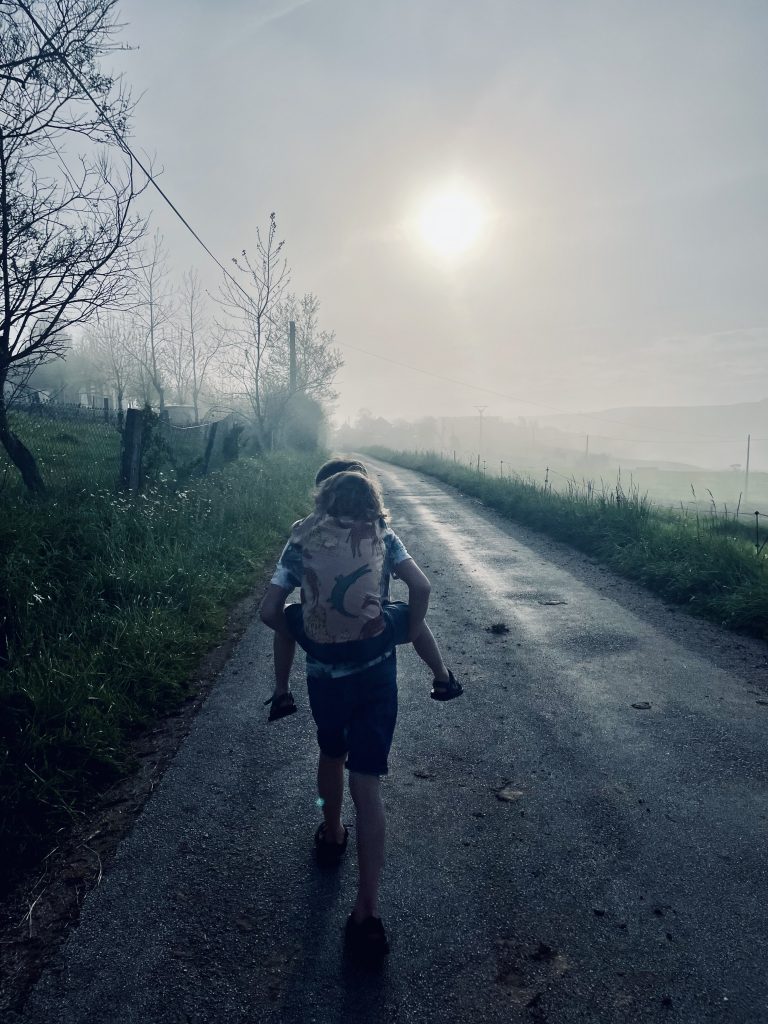
When my children run ahead on this small country road, the sea mist swallows them. I have no sense of how far the ocean is. We pass women pulling snails from wild mustard at the roadside.
“Ola,” the children chorus.
“No puedo hablar español,” we respond to the questions they ask.
The women return to their task, choosing with care the biggest snails. Their plastic bags are full – cabrillas to cook in broth with cumin, pepper, garlic and bay. I lift one; it comes away from the branch with a kiss then folds into the tight coil of its home. When I hold it in my hand, there is a gentle heat in its shell.
The Bay of Biscay
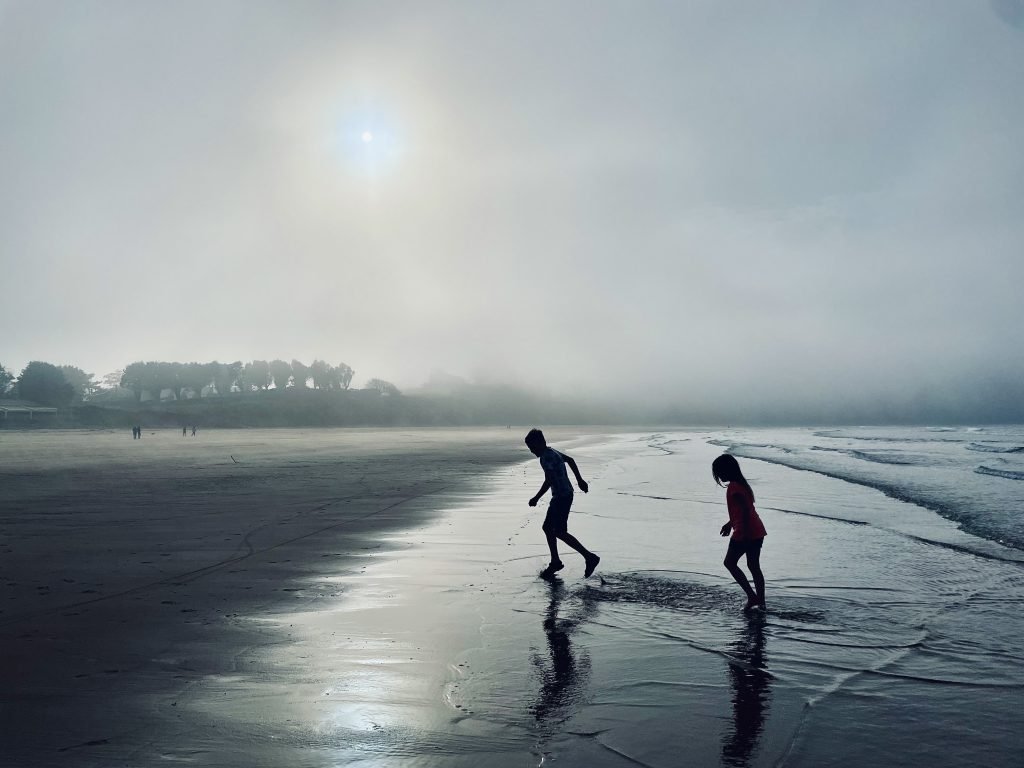
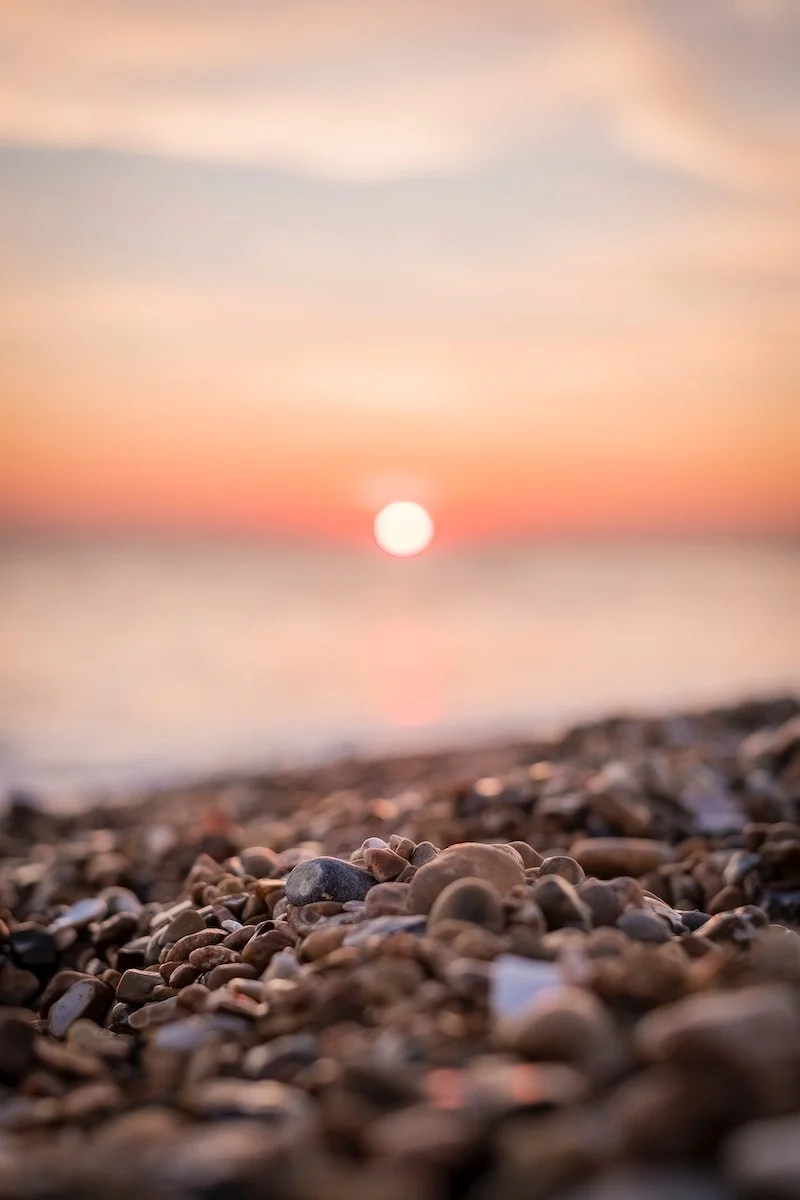
We are almost knee deep in the Atlantic by the time the Bay of Biscay materialises. Prevailing offshore winds and high humidity in Northern Spain create a belt of dense maritime mist between the sea and the mountains of the Picos de Europas. We move like spectres along the sand and into the surf while the sun burns a perfect circle above us. Playa Oyambre is deserted, and we are giddy with the joy of unscheduled time.
Last week, I held council with a group of women to celebrate the festival of Bealtaine. My dear friend led a ritual that allowed us to mine our past for nuggets of joy. We reflected on each decade and excavated our memories in search of the times we were most alive. It took a long time to move like this through our histories, feeling into the spaces where we laughed, shared food, held babies and submerged our bodies in cold water. At the end of our digging, we collated our findings. We told the stories of our deepest joy as seams that run beneath the surface of our lives.
Nuggets of Joy
On our return from the beach, the little red tractor is stalled, and the farmer is propped against the wall, deep in conversation with a neighbour. The sight of him, a blade of grass between his teeth, his cap askance to reveal tufts of white hair in the small, cut field fuels my joy. So too does the swift kestrel that skims the soil and the sound of ducks in the estuary while we fall asleep for the first time in our tent.
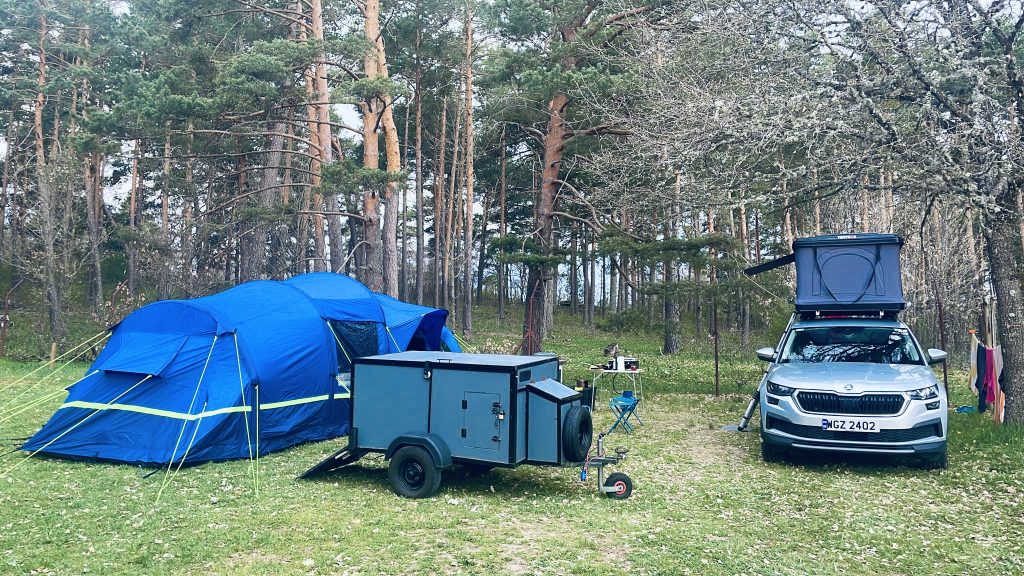
My nuggets of joy were all in the wild. That is why we are here, for the next five weeks, navigating the back roads of Northern Spain, pitching tents, cooking outdoors, and lacing our hiking boots to explore the national parks. It is not easy to exit one’s life for this long. It meant living apart to bank the necessary finances, shipping our animals out to family and friends and next level logistical planning in the garden and apiary. With all of that done, we arrived in Bilbao with no plan, no bookings and a completely open mind as to what the next month will look like.
Mary Oliver writes that joy is life’s way of fighting back. Against the humdrum, the apathy, and the regret, against social pressure, obligation and the relentless pace of a life lived in the fast lane. It is a revolutionary act when faced with suffering, the loss of loved ones and the breakdown of relationships.
In smaller ways too, it is a lifeline as we adjust to travelling. At the beginning, we are angular, sharp and impatient. It takes time to develop a rhythm, to identify the best pitch and to organise our camp in such a way that we can find the things we are looking for. It also takes time to settle into one another’s company. Yesterday, the youngest two fell out over a pine cone in a 30-acre coniferous woodland. In time, our sharp edges will be smoothed, and we’ll fall in step like the wolf packs that roam the mountains through which we walk. This is also why we are here.
Spanish Oysters
Parts of the Cantabrian coastline feel a lot like the West of Ireland: green fields, cattle, low stone walls and wild stretches of sand. The fishing ports, however, are unique. In San Vincente de la Barquera, the boys join local fishermen on the pier while my daughter and I eat oysters farmed in the estuary. We watch surfers catch waves in the mist and spend a long time in the pescaderia where huge crabs bubble in buckets of ice and a fishmonger amputates an octopus.
From there, we travel through the Cantabrian mountains. There is snow on the highest peaks and when we tunnel through the sandstone we emerge into an entirely different landscape. The mist clears, the earth turns the colour of rust, and we drive wide alluvial plains planted with wheat. On a lonely stretch of road, we see a flock of large birds circling. It turns out to be a wake of griffin vultures. To our delight, three of them sulk on a pylon at the roadside and we stop to watch them hunch and squabble.
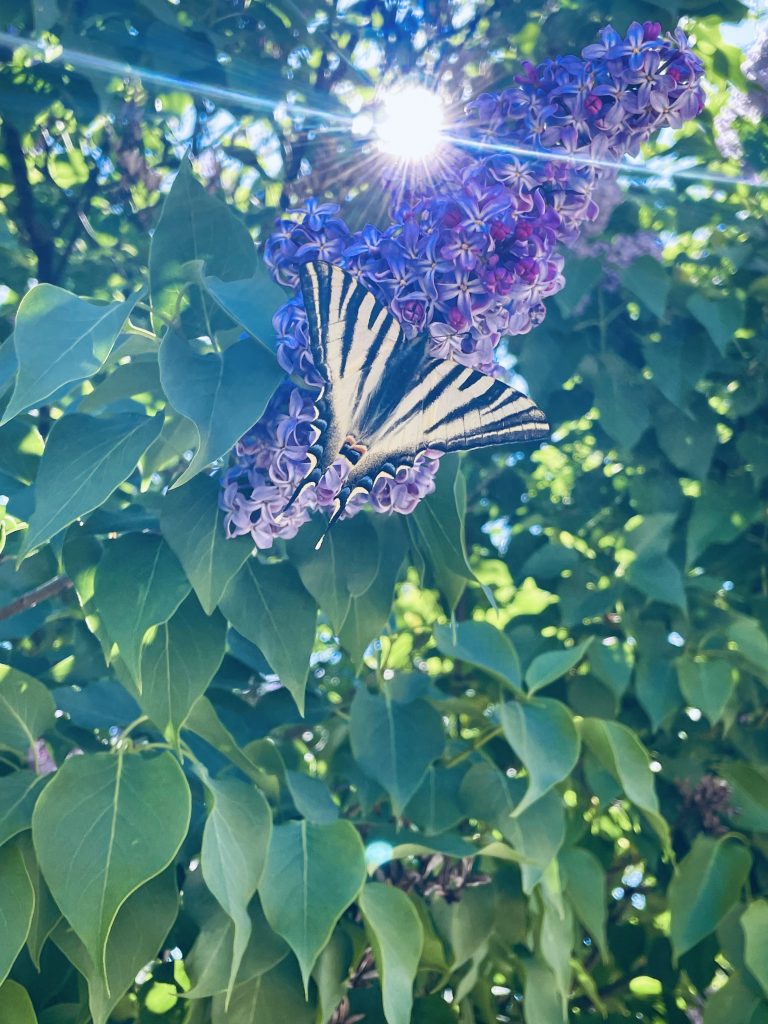
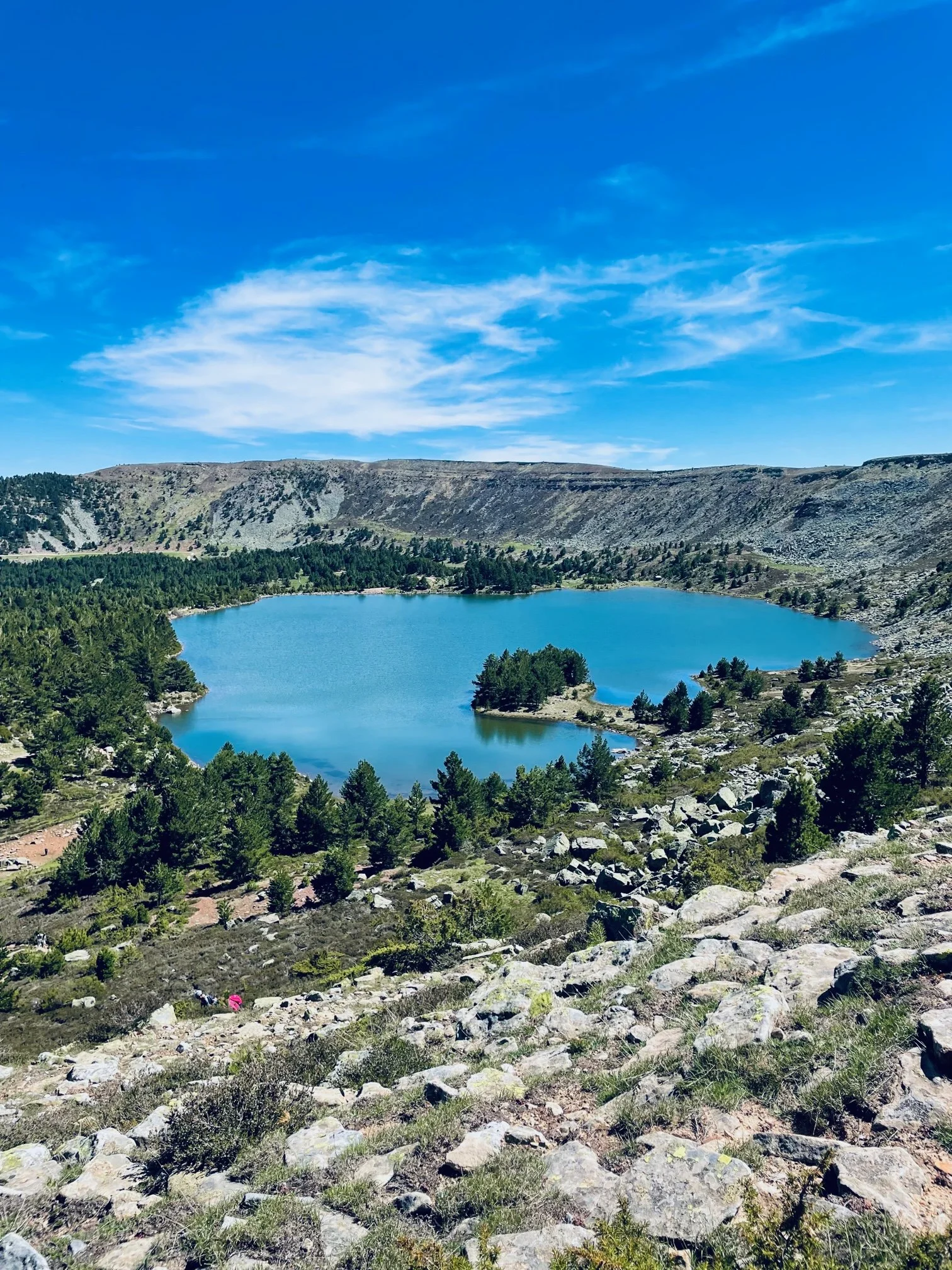
East of Burgos, the Glacial Cirques of Urbion appear on the horizon. Our road climbs through dense pine forests and we set up camp along the River Douro. This is our base from which to explore Sierra de Urbión y Laguna Negra, a 4000-hectare landscape of granite mountains and deep, black lakes. Before we set off, we stop in the local pueblo for bread and ham. If you were to wander off down a side street, past the house with lilac bushes aflutter with swallowtails, you would find a small, deserted church. There, high on the steeple, above the bell, a stork has built its nest. It is a riot of sticks threatening to topple into the street below. From it, a stork tilts its head to observe us. I will never forget the that perfect white neck, curved like a question mark against the cloudless blue sky.
Not Afraid of its Plenty
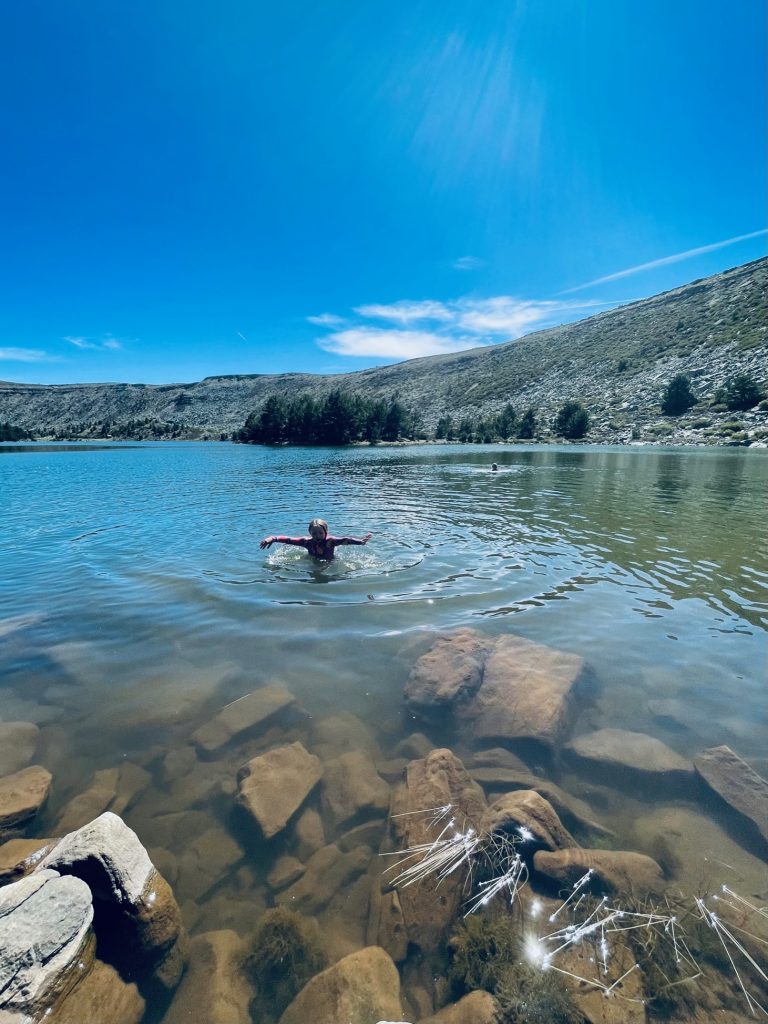
When I stand at the edge of the Black Lagoon at 2,000 metres, I recall Oliver’s words: ‘…don’t be afraid of its plenty. Joy is not made to be a crumb.’ The water was snow a few months ago. It holds the reflection of the peaks we climbed in perfect symmetry and when I dive in, it is so cold, it burns. I hear the splash of my daughter behind me - two generations of Joy casting our bread upon the water.
Next, we journey south, through the terra rosa of Aragon. The land is terraced as it steepens and olive trees rise from the dry earth in hues of blue-green and silver. It is hot here and when our trailer tyre deflates, we spend a sweaty hour in Alcañiz trying out our pidgin Spanish with a local mechanic. Of all the places in Spain to need motoring assistance, Alcañiz is ideal. It is home to Motorland Aragon, a 5 km racetrack used for motorsport. We have our pick of mechanics and accumulate a lot of tyre-related vocabulary.
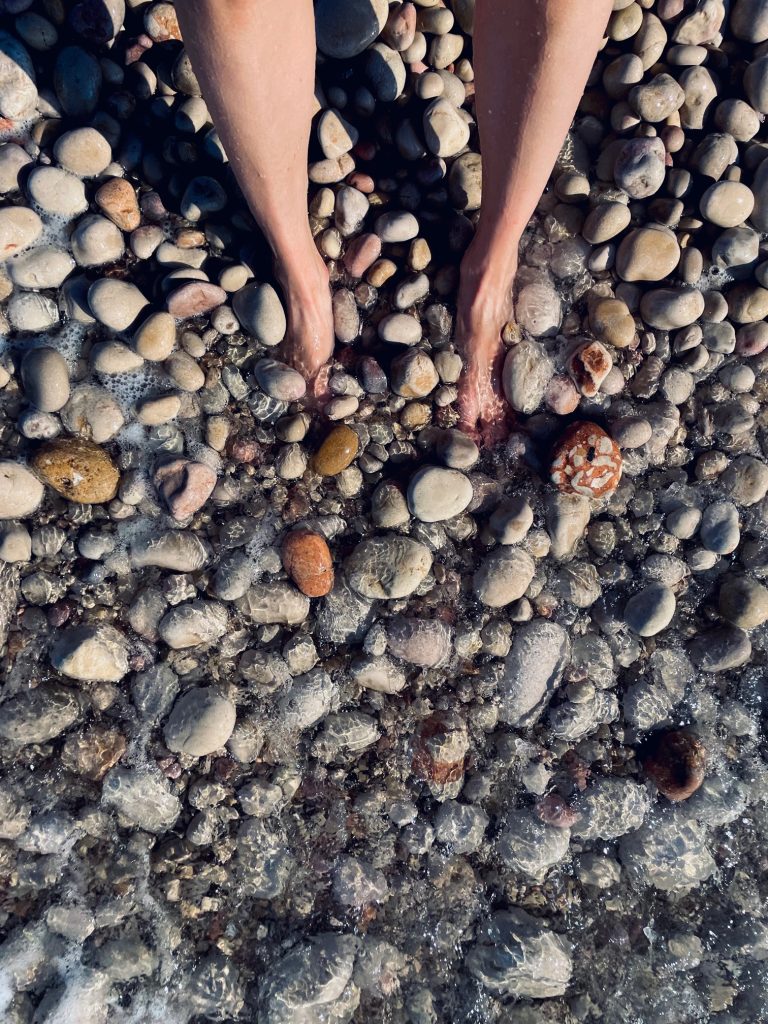
It is seven o’clock by the time we reach the Balearic Sea. Our campsite is in the heart of the Serra d’Irta National Park. We fall asleep to the sound of the sea, and I am in the water at sunrise. When I come out, the children have scattered along the beach. One is building a castle, another framing beach art with driftwood and the third staging a concert for an audience of shells. These are rich deposits of joy. I look up; a bird climbs the sky above the mountain. The sun catches its underside when it turns – it has the bright white breast of a Bonelli’s Eagle.
Latest Publications
Search Site
related journal entries


People With Whom I Have Worked