The Hidden River
Upstream
Upstream is an offering of essays that map the landscape as I see it. Subscribers get full access to my work. If you are already a member, please login below.
If you are not currently a member but would like to join, please click here.
The last time I wrote a novel I was newly married and living in a tumbledown farmhouse with four sheep and a gaggle of poultry. I rose early, drove my husband to the bus stop, swam 40 lengths in the local leisure centre then cloistered in a small writing room at the top of the house. I sat down to write like I prepared to swim: poised on the pool edge, primed, daunted, eager to be in my element. There were days it was difficult, lonely work. There were days I tended towards madness.
Once, I called my husband out of theatre to ask him how to operate his air rifle. I had hung a bird feeder outside my window to enjoy the wildlife, however two grey-backed crows barred smaller birds from the table. This black-caped mob stripped the feeder of fat balls and my fixation with them grew. What is even more surprising is that my husband, mid-anaesthetic, instructed me in how to load and fire his rifle, then returned to his work and left me to it. When the gun went off, I came to. There I was, on my belly at the sash window, operating a firearm in my pyjamas while a murder of crows mocked me from the tree.
Apprentice to the Wildwood
Fifteen years on, I am working out what a writing practice looks like within the context of family life. I find novel writing to be a deeply immersive process. The lines between fiction and fact blur and I can get lost for hours, days or weeks in the labyrinth of imaginary worlds. How can I yield to that process and then jump into my car for the school run?
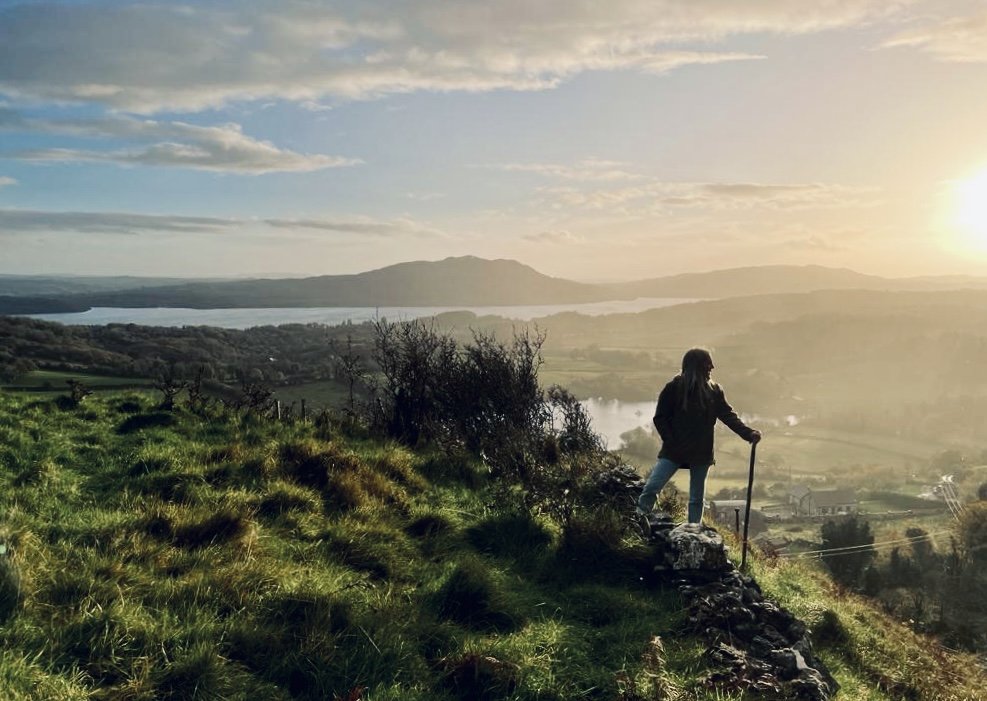
Walking is an essential part of my creative process. I have become apprentice to the 50 acres of wildwood on which I am deeply privileged to live. I walk it every day and every day I discover something different: the pert pileus of liberty cap mushrooms; the opening of a cave; a fissure from which floodwater erupts, ancient walkways and unmarked graves. Sharon Blackie calls this, ‘falling into the land’s dreaming’, that hinterland between the physical and the imaginary where I can absorb the stories of karst and hawthorn, river and bog.
I have confined my wandering to these 50 acres as a way of settling into my new surroundings. As apprentice to this area, I want to learn about its history, geology and mythology. Where we live can be as important as how we live. For example, the landscape in which I currently live is carboniferous limestone laid down over 300 million years ago. It is a soft, permeable rock so water travels through it. It disappears into swallow holes and flows underground until it hits impermeable rock and is forced above ground. I write overlooking Lough Anelton, a small lake that shrinks and expands dramatically in response to this subterranean flow of water. It challenges me to consider what American poet, William Edgar Stafford called, ‘the hidden river of my life.’
The week my first novel was published, the Head of the Arts Council told me that I needed to build on its success by writing another one as quickly as possible. I had a one-year-old at home, an eight-week-old in my womb and a husband with several sets of exams and six years of anaesthetic training left; that was not going to be my journey. It was a swallow hole moment; the river disappeared, but it did not stop flowing.
//
There was a man from Calry who walked the mountains long ago and long ago it was… so the story begins. He was a lonely man who liked to smoke. His sheep grazed the hills around my house, and he went in search of them with a crook in his hand. One day, he sat down to fill his clay pipe, but when he put his hand in his pocket, there was nothing there. He chewed on a bit of heather, then noticed a pipe full of tobacco nestled in the grass. After lighting and smoking it, the pipe remained full of tobacco. He kept it for a long time and never had need to refill it. One day, a neighbour asked if he might smoke it. The neighbour complained that the tobacco was stiff and told the man to pick and fill it. He did. It reverted to a normal pipe without any magical properties.[i]
//
Much is lost when we take the word of another over the mystery at work within us.
//
Away with the Fairies
Sometimes, I take my friends with me when I walk. One loves to teach me Irish, and I am learning how inextricably this language and landscape are connected. Gaelic comes to me like a locked box: I do not understand its pronunciation, I was not raised on its vocabulary, and it was not part of my culture. However, I am fascinated by its poetry and keen to learn.
My friend told me one afternoon about a Fόidín Mearaí (fo-jean-marra, for us non-Irish speakers), a sod of turf bewitched by fairies where ‘things shift their parameters and turn topsy-turvy’[ii]. This piece of ground is found in areas where the fairies live. If one stood on it, they would get lost, sometimes for days at a time, in fields they had crossed without bother their entire lives.
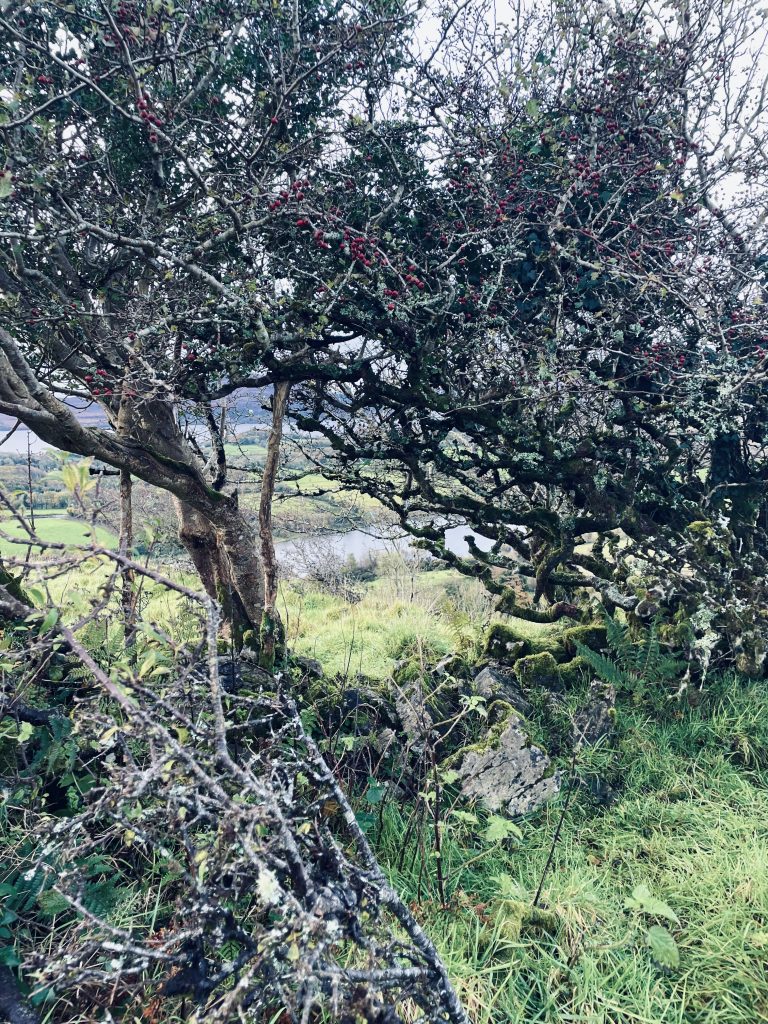
Now, I feel the need to pause here and clarify that when I say fairies, I am not referring to small, winged creatures waving magical wands, nor am I referencing squat leprechauns in green waistcoats. The Sí are remnants of Irish Gods and Goddesses that were driven underground with the coming of Christianity to Ireland. They took up residence in the hill forts and raths scattered across the countryside and tales of their power have been diluted over time.
While I have not experienced anything like the stories I heard of those afflicted by the Fόidín Mearaí, I do get lost in my thoughts when I sit atop the hill. I loosen my grip on reality (that straitjacket society tailored to fit me just so) and begin crawling into hawthorn groves or sitting on boulders until I can see the shape of things beneath the grass. I knock on my neighbours’ doors seeking stories and speak to archaeologists about the lay of this land. This hill, this hulk of limestone with its underground passages, hidden water courses and markers of sacred ceremony, is the gateway to my imagination.
You see, creativity is a flow. My work is to dislodge anything that might stem its passage. This is an unlearning of the things I have given my attention to in the first half of life. Like being good, fitting in, bettering those around me, becoming ‘successful’, being right and building a career, to name a few.
Essential to Life
I recently met a man who has a lucrative business and who might be hailed as the pinnacle of success in our modern culture. It was as if we spoke two different languages, but both wanted to understand the other. I love these opportunities. We travelled a great distance in our conversation and learned things along the way. How much money did your first novel make? He asked. Look, I responded, a heron flying low over the water.
We talked about our Curriculum Vitae. This phrase, when you unspool it and search among the thread of words and their origin, means ‘a summary of one’s education.’ Curriculum has connotations of the word ‘course’ and vitae is connected to ‘vital’ which unravels further to denote ‘manifesting life,’ or ‘belonging to life,’ or even ‘essential to life.’ When I stitch this together, my curriculum vitae is a summary of the essential course of my life, its flow from source to mouth. I could list my various academic qualifications or perhaps my work experience making cappuccinos (a writer’s rite of passage), teaching English or facilitating writing groups.
However, what I am truly interested in recording, perhaps in the margins or as an appendage to the official layout, is the river of life as it eddies around the dates of school examinations and work placements. The things we love and achieve but cannot summarise on the page.
The Cure
At school I studied history and hated it. I received consistently poor grades in the subject and never considered pursuing it beyond the confines of the classroom. Today, I am part of the Sligo Heritage and History Club. I spend an inordinate amount of time reading online archives of folklore and scholarly journals that reference the history of this place. When I talk to the locals, I mine their stories. One told me of the battle fought beside the lake over which my writing desk looks. He said the farmers unearthed human bones in the fields. Another told me of the woman nearby who has ‘the cure’. The cure for what? I asked. My neighbour’s face clouded: ‘I best not say’.
I love history but I cannot record that on my CV as anything apart from a hobby. How many of us are cut off from this need to make connections to our locality and ancestry because somewhere along the line we decided we were ‘bad’ at history? How many of us lack curiosity about the places we are from or those we visit because history was packaged in a certain way?
Let us write with invisible ink all the niche passions we pursue from cashels to mortise and tenon joints; from fine line art techniques to the intricate worlds of Fortnite; from yoga to football to electric guitar to cold water swimming. Perhaps then our CVs might be accurate reflections of the ways we find belonging and the things that have taught us how to be in the world.
//
The Insistence of Rainwater
With the recent rain, the hill on which we live is bursting at the seams. The lake has a sinkhole in one corner into which the water drains, like bathwater down a plughole, through an underground passage and into Lough Gill. The day after it rains, the water comes to ground at the bottom of our hill. There are places it erupts, volcano-like from the rock.
Most mornings, I walk the dogs down there in the dark. We take a steep path to the lakeside where water forces its way to the surface between two large rocks. I take palmfuls and splash it on my eyes. Help me see clearly, I say.
My work has come to ground with the same energy and insistence as this water. I am learning to harness it in the hours I spend alone. Since arriving in Sligo three months ago, I have completed the first draft of my novel. It is a wonderful thing to feel the flow of words that I have banked over the last decade. I think of the afternoons walking trails with my children, drinking the forest, or the days we hiked in the Mournes in search of river sources. I think of the hard days, the best-time-of-my-life days, the boring days, and the ones we chased sparks into the most unlikely places.
I have not consistently worked on a novel for more than a decade but every day I was a writer. Nothing was ever wasted. My work has been to cultivate receptivity to whatever the day holds. It is a way of seeing, beholding domestic details with as much reverence as I might afford the rose.
It is important to acknowledge, however, how hard it can be when the river of our life's passion disappears underground for long periods of time. This may be through choice, or it may be in response to the unstoppable flow of life as it courses through different landscapes: parenthood, illness, relational breakdown, the death of loved ones, career success, financial struggle, religious emancipation, spiritual exploration. There is a certain trust required in the way of water. Perhaps this is why we are drawn to walk beside the sea, around lakes and along riverbanks, the water reminds us of who we really are.
Coming Ashore
After a day of writing, I put my head above water and come ashore in the Sudbury School. I scan the horizon for two of my children who, together with their friends, have established a flourishing micro-community in the school field. They spend their days in ‘Tunnel Town’, a warren of paths through the long grass to rooms constructed from hay and wooden pallets. They elect members, deal with disputes and channel their work to good ends. At home time, my children have empty tummies and full lunchboxes. We just didn’t have time to eat, mum.
Then, I wait for my eldest to appear from the music room shouldering a guitar case, flanked by his band members. They tell me about the songs they have written and the challenge of transferring them onto CDs. One references Beethoven and Malcolm Young in the same sentence, another reminds my son to practice his guitar riff until he sounds like Slash.
(How might we summarise this on a CV?)
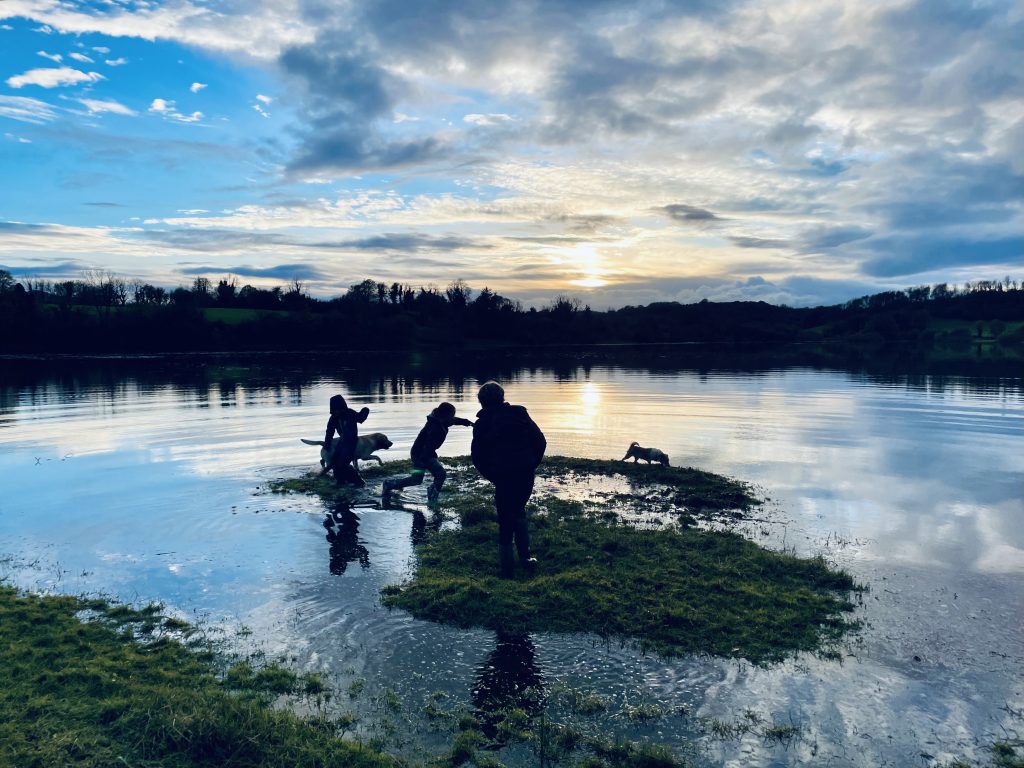
When we get home, we skip down to the lake to assess the water level. Sometimes we swim, mostly the children get as wet as if they had. This cold-water therapy helps us fall in stroke again after a day of getting lost in our own worlds.
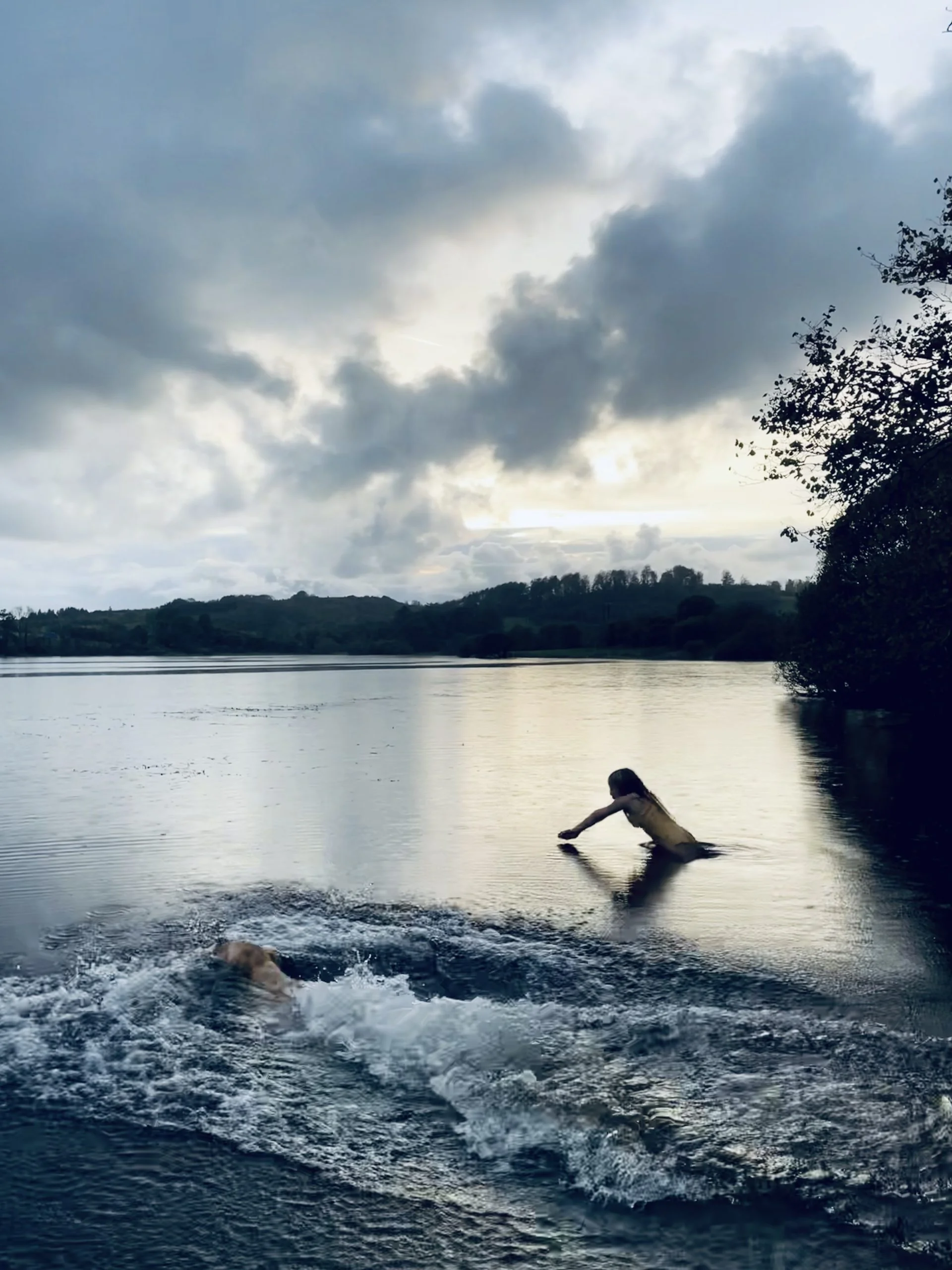
There is much scientific debate about the capacity of water to hold memory. I have been consistently poor at science my whole life, so I will not weigh in on that. However, I do like to think about the ways in which water might remind me of the places I have been. When I slip like otter beneath the freezing surface of the lake, I ask to remember how to be a writer, how to come home to this core part of myself while keeping hold of the rest. Then I let go, I fall back on the generosity of the lake and allow it to bear me up. My children and I float like flotsam, rinsing the day from our bodies before climbing the hill home.
[i] From the National Folklore Collection UCD Digitization Project, www.duchas.ie.
[ii] From Listen to the Land Speak by Manchan Magan.
Latest Publications
Search Site
related journal entries


People With Whom I Have Worked








Leave a Reply